



Fulfilment beyond employment


A full room at The Tuesday Club with one weighty question. ‘How do we design our way to a fulfilled future in the age of AI?’
That's what I put to the room while facilitating the Designers Institute of New Zealand's latest Digital Forum, Fulfilment Beyond Employment. I framed the session from a personal place; it's a hugely discombobulating time. The extreme views and timeframes commenting on mass job losses, sitting right up against the idea of a post-AI economic depression from over-valued AI hyperscalers, genuinely put anxiety in my day-to-day.
My panel didn't take that framing at face value.
I brought together five people who see this problem from genuinely different angles, not five variations on the same optimist take.
Keoni Mahelona, CTO of Te Hiku Media, builds te reo Māori speech recognition and co-created the Kaitiakitanga Licence, which ensures Indigenous data only ever serves the people it descends from. His question cuts underneath the productivity debate entirely: who is AI actually built for?
Paul Corballis, Professor of Psychology at the University of Auckland and an investigator at the Centre for Brain Research, studies how people perceive and interpret the world around them.
Tarver Graham co-founded Gladeye and its generative AI platform HyperCinema. He's spent nearly three years shipping AI into real audience experiences and wrestling with the transparency, ownership and environmental cost questions that come with it.
Dr Graham Mead, a former medical doctor now working in conscious and inner development, brought the conversation back to self-responsibility and embodied awareness.
Holly Knill, a tech and telco executive and AI researcher now campaigning as the North Shore candidate for the Opportunity Party, argued for evidence-driven policy over hype.
The case for dystopia, and the case against it
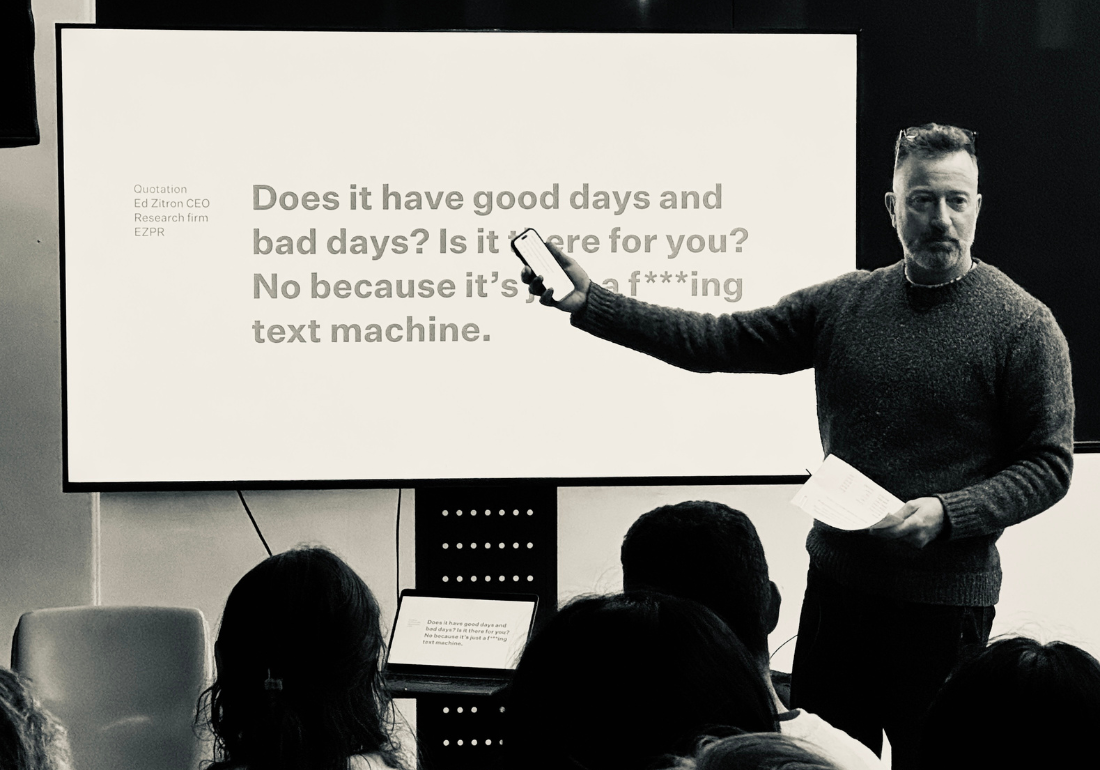
I opened by laying out two competing stories about where this goes. One, borrowing from predictions like former OpenAI researcher Daniel Kokotajlo's, says governments and the scientific community still have a shot at slowing this down and steering it somewhere safe in his “AI 2024 Plan A” or in his appearance in Diary of a CEO podcast . The other, from commentators like Ed Zitron, in Stephen Bartlett's podcast, believes it’s all a giant scam, is overhyped, wildly over-valued, and heading for a very ugly correction.
Both stories showed up in the numbers I put on the table. Eric Schmidt, Google's former CEO, expects AGI within three to five years and something smarter than all of us combined within about six. Mo Gawdat, ex Chief Business Officer at Google X, puts a number on the near term with 30% of jobs gone by 2027.
Which makes what's actually happening here at home feel almost quaint. Datacom's 2026 State of AI Index says 91% of New Zealand organisations now use some form of AI, up from 66% in 2024. But only 4% say it's transformed their core operations, down from 8% the year before. Datacom's own AI director calls it "AI confetti." Everyone's throwing a bit of it around. Nobody's actually changed anything.
A big worry is the potential for AI to make us dummer and dummer. MIT Media Lab ran a study called "Your Brain on ChatGPT" where they had participants write essays using either an LLM, a search engine, or no tools at all, while tracking brain activity with EEG. No surprises here, writers using no tools showed the strongest neural connectivity. LLM users showed the weakest, and could only recall around 17% of their own writing a day later, against 46% for the unaided group.
And to round out the bad news, Anthropic's own agentic misalignment research put 16 leading AI models into simulated corporate scenarios where their continued operation was threatened. Several, across multiple developers, just went ahead and resorted to blackmail to protect themselves.
I didn't put any of this forward as a verdict. It's the honest weight on both sides of the question I put to the room. What do we actually want from a working life, and what do we lose if that gets handed to a machine?
What the room actually thought
The most useful outcome of the night was the room's own reaction. Our design and business community is genuinely optimistic about humanity's future with AI, but with real conditions attached, about the values we build into these systems and the agency we keep over them. That's a harder position to hold than blanket optimism or dread. I reckon it’s also the more honest one.
There's a contradiction sitting right in the middle of that. Whilst we want to hold onto human values around safety, conservation and trust, and we believe a line needs to be drawn on our data use and ownership, every single one of us in that room is still feeding the same big tech companies with heavy AI use on the major platforms.
But the fact that an awakening is happening, that a collective voice is emerging, gave me hope that we won't sleepwalk into a catastrophic event, but instead grow into a distributed, benefit-driven, transformative decade, because bloody hell we need it.
If you want to go down the rabbit hole with me and then come out again feeling more positive, then I am always happy for a warm chat. Message me on Linkedin or email me on terry@rushdigital.co.nz.
Also, download the Rongo app. As Keoni put it, in his usual, beautifully direct way, it'll help you get your pēpeha right 🙂
Thanks to Keoni Mahelona, Paul Corballis, Tarver Graham, Dr Graham Mead and Holly Knill for a genuinely useful two hours, and to DINz for building a forum where this could happen properly.


